
Colorado Comfort Products: Premium Home Heating Stove Installation in Breckenridge, CO
Living in Breckenridge means embracing the beauty of the Rockies, but it also requires being prepared for harsh winters and heavy snowfall. At Colorado Comfort Products, we understand that a reliable heating source is more than just a luxury – it’s often a necessity. Our team specializes in the installation of high-quality wood and gas stoves that are designed to perform reliably in our specific mountain environment. We take pride in helping homeowners find the perfect heating solution that balances aesthetic appeal with functional warmth. Whether you are looking to add a rustic wood stove to a log cabin or a sleek gas insert to a modern condo, we have the expertise to handle the installation as effectively as possible.
What Types of Heating Stoves Do We Offer?
We focus our inventory on the two most reliable and popular fuel sources for mountain living: wood and gas. We believe these options provide the best balance of heat output, ambiance, and dependability for Breckenridge homeowners. By narrowing our focus to these two distinct categories, our technicians can maintain a deeper level of expertise in installing and servicing these specific units to ensure they perform as efficiently as possible.
When you work with us, we help you choose between these two primary categories based on your lifestyle and heating goals:
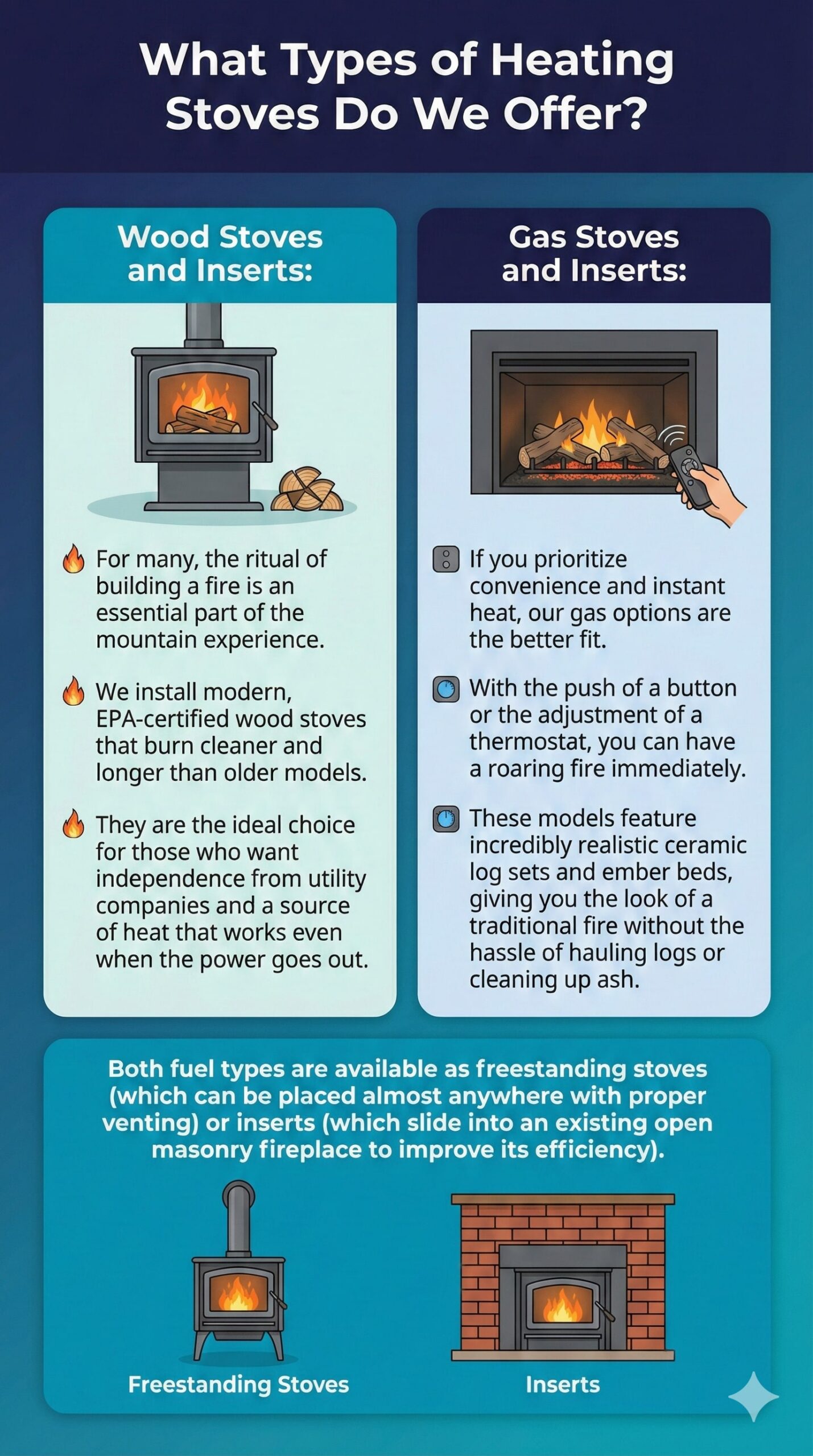
- Wood Stoves & Inserts: For many, the ritual of building a fire is an essential part of the mountain experience. We install modern, EPA-certified wood stoves that burn cleaner and longer than older models. These units are designed to extract more heat from every log, reducing emissions and extending burn times so you aren’t waking up every two hours to reload. They are the ideal choice for those who want independence from utility companies and a potent source of radiant heat that works even when the power goes out.
- Gas Stoves & Inserts: If you prioritize convenience and instant heat, our gas options are the better fit. With the push of a button or the adjustment of a thermostat, you can have a roaring fire immediately. We install direct-vent gas units that are sealed from the room, preserving indoor air quality while providing efficient zone heating. These models feature incredibly realistic ceramic log sets and ember beds, giving you the look of a traditional fire without the hassle of hauling logs or cleaning up ash.
Both fuel types are available as freestanding stoves (which can be placed almost anywhere with proper venting) or inserts (which slide into an existing open masonry fireplace to improve its efficiency).
Our selection ranges from cast-iron classics with intricate detailing to contemporary steel units with clean lines and large viewing windows, ensuring we have a stove that complements your home’s decor.
How Do We Determine the Best Location for a New Heating Stove?
One of the first decisions we help homeowners make is where to place their new heating appliance. While aesthetics are important, the physical location of the stove plays a massive role in how well it heats the home and how complicated the installation will be. We look at the home’s layout to maximize heat distribution while minimizing venting difficulties.
When planning an installation, we evaluate several key factors:
- Centralized Heating: To get the most out of your stove, it is usually best to place it in a central area of the main floor. Heat naturally moves from warmer areas to cooler ones, so a central location allows that warmth to radiate into adjacent rooms and drift upstairs to lofts or bedrooms.
- Venting Pathways: Every stove needs a way to exhaust fumes. We look for a location that allows for a straight, vertical vent run through the roof. Avoiding elbows and horizontal runs usually leads to better draft and easier cleaning later on. We also have to check for obstructions in the attic, such as trusses, wiring, or plumbing, that might interfere with the pipe.
- Floor Protection: Wood stoves require a non-combustible hearth pad to protect the floor from embers and heat. We help you determine if your chosen spot has enough space for the required clearances to walls and furniture, ensuring the setup is safer for your family.
- Airflow Dynamics: In homes with high cathedral ceilings—common in Breckenridge—heat can get trapped at the peak. We often suggest installing ceiling fans in conjunction with the stove to push that warm air back down to the living space.
By carefully considering these logistics before we cut any holes, we ensure that the final installation looks natural and performs as efficiently as possible for the specific layout of your home.
Serving the Heart of the Rockies: Our Connection to Breckenridge
Breckenridge is a town that captivates visitors and residents alike. It is a place where history meets adventure, and we are incredibly proud to offer our services to this vibrant community. Walking down Main Street feels like stepping back into the Gold Rush era, with its beautifully preserved Victorian architecture and colorful storefronts. We love that this town has managed to maintain its authentic character while becoming a world-class destination for skiing and outdoor recreation.
There is something special about the community spirit here. From the locals gathering at Blue River Plaza to the excitement of the International Snow Sculpture Championships, Breckenridge is always alive with energy. We enjoy spending our downtime hiking the trails near Carter Park or taking in the views from Boreas Pass. Because we live and work in the mountains, we understand why people choose to make their homes here. We know that after a long day on the slopes or a chilly evening walk through town, there is nothing better than coming home to a warm fire. That local connection drives us to provide the highest level of service to our neighbors.
Will a Heating Stove Work During Power Outages Common in Winter Storms?
In Summit County, heavy winter storms can occasionally lead to power outages. For homeowners relying solely on electric baseboard heat or a furnace that requires electricity to run the blower and ignition, a blackout during a blizzard can quickly become a serious situation. Installing a heating stove is one of the most effective ways to provide a backup heat source, but the type of stove you choose determines how well it functions when the grid goes down.
Here is how different stove types perform during a power failure:
- Wood Stoves: These are the ultimate backup. They require no electricity to operate. As long as you have dry wood and a way to light the fire, you have a potent source of radiant heat that can keep a main living area warm even when the rest of the house is freezing.
- Gas Stoves & Inserts: Many modern gas stoves operate with a standing pilot or an electronic ignition system with a battery backup. This allows the burner to light even without household power. While the electric blower fan will not work, the unit will still radiate heat from the glass and metal body, providing a critical source of warmth.
Without the central furnace fan blowing, heat will not circulate to distant bedrooms. We advise placing the stove in a central location to maximize passive heat flow.
We help homeowners assess their emergency heating needs. For those in remote areas or those concerned about pipe freezing during outages, we often recommend wood or battery-backup gas units as the most resilient options. It provides peace of mind knowing that no matter what the weather does outside, you have a way to stay warm inside.
How Do We Protect Venting Systems From Sliding Snow and Ice Dams?
Roof avalanches are a real phenomenon in Breckenridge. When feet of snow accumulate on a pitched roof and then release all at once, the force can shear off plumbing vents, chimneys, and stove pipes as if they were made of paper. Installing a stove here requires more than just cutting a hole in the roof; it requires a strategic plan to protect the venting system from the crushing weight of moving snow.
We employ several strategies to mitigate the risk of snow damage:
- Strategic Placement: The best defense is placing the chimney penetration near the peak (ridge) of the roof. This minimizes the amount of snow that can accumulate above the pipe, reducing the potential load that can slide into it.
- Snow Splitters and Crickets: If the pipe must be lower on the roof, we install heavy-duty snow splitters or crickets (a peaked structure built behind the chimney). These divert the sliding snow around the pipe rather than letting it hit the pipe head-on.
- Heavy-Gauge Bracing: Standard bracing often isn’t enough for mountain snow loads. We use reinforced, adjustable roof braces that anchor the pipe securely to the roof structure, providing extra stability against lateral forces.
- Chimney Height: We must balance the need for draft (taller is better) with the risk of wind and snow load. Sometimes, an enclosed chase (a framed wooden structure around the pipe) is necessary to provide the structural integrity needed to survive a heavy winter.
Furthermore, we consider the formation of ice dams. As heat escapes the chimney, it can melt snow on the roof, which then refreezes at the eaves. Proper insulation around the chimney penetration is crucial to prevent this heat transfer. We take extra care to seal and insulate the pass-through area to minimize ice buildup that could damage your flashing or roof shingles.
Can Modern Home Sealing Affect How a Stove Drafts?
New construction in Breckenridge (and even retrofitted older homes) prioritizes energy efficiency. This means better insulation, high-performance windows, and house wrap that creates an extremely airtight envelope. While this is excellent for retaining heat, it creates a challenge for wood and gas stoves known as “negative pressure.” A stove needs to pull air from the room to feed the fire. If the house is too tight, the stove struggles to “breathe,” leading to poor combustion, smoke spilling back into the room, or even back-drafting of carbon monoxide.
We address this through specific installation protocols:
- The Stack Effect: In tall mountain homes, warm air rises to the upper levels, creating high pressure at the top and low pressure in the basement or ground floor. If a stove is installed in the lower level of a leaky house, it fights this natural pressure. In a tight house, the effect is magnified.
- Competition for Air: Appliances like kitchen range hoods, bathroom fans, and clothes dryers actively pump air out of the house. In a tight home, running the range hood can actually suck air down the chimney to replace what is being exhausted, pulling smoke into your living room.
- Dedicated Outside Air: This is the primary solution. We install a direct duct from the stove to the exterior of the home. This “Outside Air Kit” (OAK) allows the stove to be a sealed system, drawing its own combustion air from outside rather than competing with your dryer or lungs for indoor air.
- Make-Up Air Systems: In some cases where large range hoods are present, we may recommend a make-up air system that mechanically brings fresh air into the home whenever an exhaust fan is turned on, balancing the pressure.
We assess the “tightness” of your home before we begin installation. By understanding the airflow dynamics of your specific property, we can design a system that drafts correctly, regardless of how well-insulated your walls are. This ensures you get the efficiency of a modern home without sacrificing the performance of your stove.
How Do Freeze-Thaw Cycles Impact Roof Flashing and Waterproofing?
The Colorado high country is famous for its “bluebird days” followed by freezing nights. This constant fluctuation between warm, sunny afternoons and sub-zero nights creates a freeze-thaw cycle that is brutal on building materials. For a stove installation, the most vulnerable point is where the pipe penetrates the roof. If the flashing and sealants are not chosen and applied correctly, the expansion and contraction caused by these temperature swings can break the watertight seal, leading to leaks that may go unnoticed until significant damage is done.
We utilize materials and techniques specifically designed for this thermal stress:
- Flexible Sealants: Standard caulk becomes brittle and cracks in extreme cold. We use high-performance, industrial-grade silicone and sealants that remain flexible even at temperatures well below freezing. This allows the materials to expand and contract with the metal pipe without breaking the bond.
- Storm Collars: We install storm collars—a metal skirt that fits around the pipe just above the flashing. This acts as an umbrella, shedding water away from the sealed joint where the pipe meets the roof flashing.
- Dead Soft Aluminum or Lead Flashing: On uneven roofing materials common in mountain homes, like corrugated metal or heavy shake, we use malleable flashing materials that can be formed tightly to the roof profile. This reduces gaps where water could pool and freeze.
- Ice and Water Shield: Underneath the visible flashing, we adhere a self-sealing membrane directly to the roof deck. If water does manage to get past the primary flashing (perhaps due to an ice dam), this secondary barrier protects the wood sheathing from rot.
We also educate our clients on the importance of annual inspections. A seal that looks good in October might have been compromised by a massive ice sheet in March. Checking the storm collar and flashing condition is a standard part of our maintenance recommendations to ensure your ceiling stays dry.
Ready for a Warmer Winter in Breckenridge?
At Colorado Comfort Products, we are dedicated to enhancing your mountain living experience through superior stove installation and service in Breckenridge. We know that a fireplace or stove is the heart of a mountain home, providing a gathering place for friends and family to share stories after a day of adventure. We treat your home with the same care and respect we would our own, ensuring that every installation is performed as safely and efficiently as possible.
Don’t wait until the first blizzard hits to think about your heating needs. Whether you need a new installation, a replacement for an outdated unit, or a consultation on the best fuel source for your property, we are here to help.